



-
Gessure Medical
-
1
-
ISO \ CE \ FDA\ FSC\ MDSAP
-
Titanium Alloy
-
Custom service supported
-
7–14 Days (OEM: 15–30 Days)
Product Overview
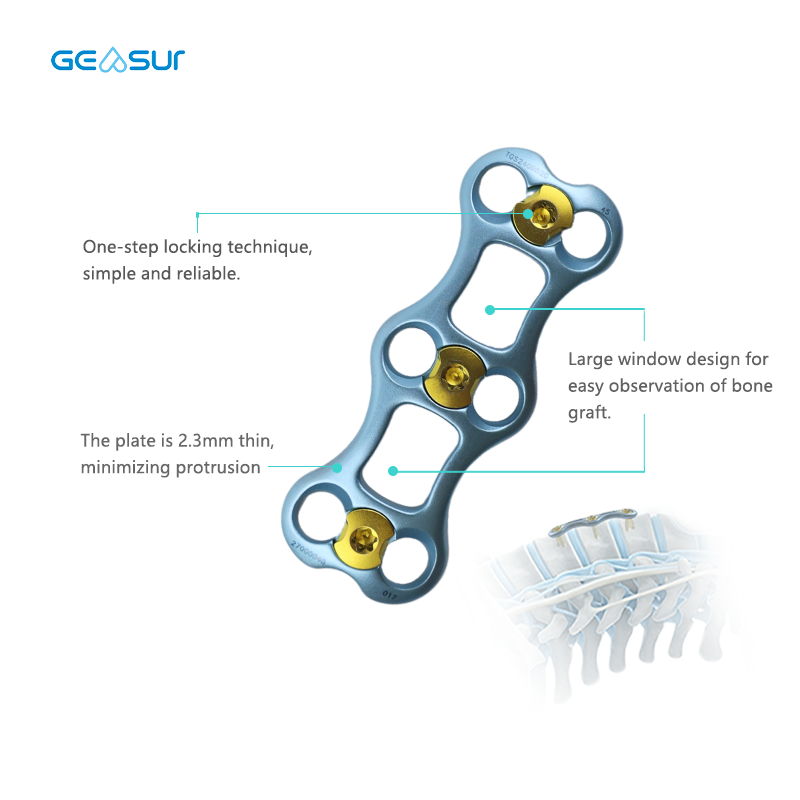
The Anterior Cervical Plate System is a state-of-the-art internal fixation device designed for anterior cervical discectomy and fusion (ACDF) procedures. Manufactured from high-strength titanium alloy, this system features a low-profile 2.5 mm plate thickness with a large central window for direct visualization of graft position and fusion status. The longitudinal 1.5 m arc radius closely matches the natural cervical lordotic curvature, while the transverse arc design creates a medial screw convergence that enhances pullout strength. The system offers both fixed-angle and variable-angle self-tapping screws in 4.0 mm and 4.5 mm diameters, with a hybrid locking mechanism combining spring-loaded and compression-style locking in a single-action step. Available in lengths from 19 mm to 75 mm, this versatile system addresses one-level through five-level cervical pathologies, providing surgeons with flexible construct options—including constrained, semi-constrained, and hybrid fixation configurations—to optimize clinical outcomes.
Indications for Use
The Anterior Cervical Plate System is indicated for the following clinical scenarios:
Cervical degenerative disc disease at levels C2–C7 requiring anterior discectomy and interbody fusion (ACDF) with plate augmentation.
Cervical disc herniation with radiculopathy or myelopathy where anterior decompression and stabilization are indicated.
Cervical spinal stenosis requiring multi-level decompression and anterior column reconstruction with plate fixation.
Cervical trauma including fracture-dislocations, flexion-compression injuries, and burst fractures requiring anterior stabilization.
Cervical spondylosis with segmental instability where rigid or semi-rigid fixation is necessary to maintain alignment.
Post-traumatic cervical kyphosis requiring corrective osteotomy and anterior instrumentation.
Tumorous lesions of the cervical spine requiring corpectomy and strut grafting with supplemental plate fixation.
Revision surgery for pseudoarthrosis or failed prior fusion, where the availability of revision screws accommodates previously drilled trajectories.
Key Advantages
The Anterior Cervical Plate System offers a comprehensive range of clinical benefits that address the unique challenges of anterior cervical spine surgery.
Anatomically Contoured Design – The longitudinal 1.5 m arc radius precisely matches the natural cervical lordotic curvature, ensuring plate-bone conformity that reduces the risk of screw pullout and adjacent segment stress. The transverse arc design creates a medial screw convergence angle that enhances screw purchase in the vertebral bodies, providing superior fixation strength even in osteoporotic bone.
Generous Central Window – The large open window design allows for direct visualization of the bone graft or interbody cage during and after implantation. This feature enables surgeons to confirm graft position, assess fusion progression, and detect any complications without plate removal, significantly improving intraoperative decision-making and postoperative monitoring.
Low-Profile 2.5 mm Thickness – The reduced plate profile minimizes soft tissue irritation and lowers the risk of dysphagia—one of the most common complications following ACDF. This low-profile design also reduces the prominence of the implant against the esophagus and prevertebral fascia, improving patient comfort and swallowing function.
Single-Action Locking Mechanism – The plate features an integrated spring-loaded and compression-style locking mechanism that engages with a single motion. This intuitive design simplifies the surgical workflow, reduces operative time, and ensures secure locking of all screw heads. The locking mechanism is available in both spring-loaded and compression configurations, both requiring only a single action for reliable fixation.
Versatile Screw Options – The system offers a comprehensive range of screw types and configurations to accommodate varying clinical needs:
Fixed-angle screws – provide rigid, constrained fixation for maximum stability in complex fractures or multi-level constructs.
Variable-angle screws – allow up to 15° of angulation for optimal screw placement in challenging anatomy, accommodating screw trajectory variations during surgery.
Self-tapping screws – for standard screw placement without pre-tapping.
Self-tapping self-drilling screws – combine drilling and tapping in one step, reducing surgical time and instrument exchange.
Revision screws – with oversized diameters for salvage fixation in previously drilled holes, essential for revision surgeries.
Constrained and Semi-Constrained Construct Options – The system can be configured as a constrained construct (using fixed-angle screws bilaterally) for rigid segmental stabilization, or as a semi-constrained construct (using variable-angle screws) that allows controlled micro-motion to promote fusion while maintaining alignment. Hybrid configurations combining fixed and variable screws on alternating levels provide additional flexibility.
Comprehensive Sizing Matrix – Available in lengths ranging from 19 mm to 75 mm, with 2.5 mm increments between 19 mm and 47.5 mm, and 5 mm increments from 50 mm to 75 mm, the system accommodates any cervical length from one-level to five-level constructs. This comprehensive range reduces inventory requirements while ensuring the right fit for every patient.
Technical Specifications & Sizing
Size Range Overview
The Anterior Cervical Plate System offers plate lengths from 19 mm to 75 mm, with both fixed-angle and variable-angle self-tapping screws in 4.0 mm and 4.5 mm diameters.
Detailed Dimension Tables
Anterior Cervical Plates
Length (mm) | Product Code |
|---|---|
19 | 27000019 |
21 | 27000021 |
23 | 27000023 |
25 | 27000025 |
27 | 27000027 |
27.5 | 27000027.5 |
30 | 27000030 |
32 | 27000032 |
32.5 | 27000032.5 |
35 | 27000035 |
37 | 27000037 |
37.5 | 27000037.5 |
40 | 27000040 |
42 | 27000042 |
42.5 | 27000042.5 |
45 | 27000045 |
47 | 27000047 |
47.5 | 27000047.5 |
50 | 27000050 |
52 | 27000052 |
52.5 | 27000052.5 |
55 | 27000055 |
57 | 27000057 |
57.5 | 27000057.5 |
60 | 27000060 |
62 | 27000062 |
62.5 | 27000062.5 |
65 | 27000065 |
67 | 27000067 |
67.5 | 27000067.5 |
70 | 27000070 |
72 | 27000072 |
72.5 | 27000072.5 |
75 | 27000075 |
Note: Plate lengths correspond to the distance between the outer screw holes. The 2.5 mm standard plate thickness is consistent across all lengths. The plate is supplied non-sterile and requires sterilization prior to use.
Screw Options
Screw Type | Diameter (mm) | Length (mm) | Product Code |
|---|---|---|---|
Variable-angle self-tapping | 4.0 | 12 | 27001212 |
Variable-angle self-tapping | 4.0 | 14 | 27001214 |
Variable-angle self-tapping | 4.0 | 16 | 27001216 |
Variable-angle self-tapping (adjustable angle) | 4.0 | 12 | W27011212 |
Variable-angle self-tapping (adjustable angle) | 4.0 | 14 | W27011214 |
Variable-angle self-tapping (adjustable angle) | 4.0 | 16 | W27011216 |
Variable-angle self-tapping (adjustable angle) | 4.0 | 18 | W27011218 |
Fixed-angle self-tapping | 4.0 | 12 | 27001412 |
Fixed-angle self-tapping | 4.0 | 14 | 27001414 |
Fixed-angle self-tapping | 4.0 | 16 | 27001416 |
Variable-angle self-tapping | 4.5 | 12 | 27001312 |
Variable-angle self-tapping | 4.5 | 14 | 27001314 |
Variable-angle self-tapping | 4.5 | 16 | 27001316 |
Variable-angle self-tapping (adjustable angle) | 4.5 | 12 | W27004512 |
Variable-angle self-tapping (adjustable angle) | 4.5 | 14 | W27004514 |
Variable-angle self-tapping (adjustable angle) | 4.5 | 16 | W27004516 |
Variable-angle self-tapping (adjustable angle) | 4.5 | 18 | W27004518 |
Fixed-angle self-tapping | 4.5 | 12 | 27001512 |
Fixed-angle self-tapping | 4.5 | 14 | 27001514 |
Fixed-angle self-tapping | 4.5 | 16 | 27001516 |
Recommended Companion Instrument Set
The Anterior Cervical Plate System is supported by a dedicated instrument set for precise implantation:
Instrument Name | Description | Specification | Quantity | Code |
|---|---|---|---|---|
Plate Bending Pliers | For minor plate contouring adjustments | Standard | 1 | 90011601 |
Plate Fixing Pin | Temporary plate fixation pin | SW2.5 | 2 | 90011602 |
Plate Fixing Pin Driver | For pin insertion and removal | SW2.5 | 1 | 90011603 |
Plate Holder | For secure plate grasping during positioning | Standard | 1 | 90011604 |
Fixed Angle Drill Guide | For fixed-angle screw placement | 85° | 1 | 90011605 |
Adjustable Angle Drill Guide | For variable-angle screw placement | 85° | 1 | 90011606 |
Drill Bit | For pilot hole preparation | 2.5×13 mm | 1 | 90011607 |
Depth Gauge | For screw length measurement | 30 mm | 1 | 90011608 |
Quick-Change Handle | For rapid instrument exchange | Standard | 2 | 90011609 |
Tap | For thread preparation (4.0 mm screw) | 4.0×13 mm | 1 | 90011610 |
Tap | For thread preparation (4.5 mm screw) | 4.5×13 mm | 1 | 90011611 |
Screwdriver | For screw insertion | SW2.5 | 1 | 90011612 |
Locking Driver | For locking mechanism engagement | Standard | 1 | 90011613 |
Adjustable Drill Bit | For variable-angle drilling | 2.5×12–18 mm | 1 | 90011614 |
Adjustable Bit Regulator | For drill bit depth control | Standard | 1 | 90011615 |
Adjustable Tap | For variable-angle thread preparation | 4.0×12–18 mm | 1 | 90011616 |
Vertebral Spreader (Left) | For disc space distraction | Left | 1 | 90011617 |
Spreader Bolt | For spreader fixation | SW4 | 2 | 90011618 |
Spreader Bolt Driver | For bolt tightening | SW4 | 1 | 90011619 |
Awl | For entry point preparation | Φ2.0 | 1 | 90011620 |
Vertebral Spreader (Right) | For disc space distraction | Right | 1 | 90011621 |
Screw Box | For screw organization and storage | Standard | 1 | 90011622 |
Instrument Box | For sterilization and storage | Standard | 1 | 90011623 |
RFQ – Request for Quotation
Q1: What is the difference between fixed-angle and variable-angle screws, and when should each be used?
A: Fixed-angle screws provide rigid, constrained fixation with a predetermined trajectory (typically 85°), creating a fixed construct that maximizes stability. This configuration is recommended for multi-level constructs, fracture-dislocations, or patients with poor bone quality where maximum rigidity is desired. Variable-angle screws allow up to 15° of angulation, accommodating anatomical variations and enabling optimal screw placement even when the plate's screw hole trajectory does not perfectly align with the vertebral body. These screws are typically used in single-level procedures or when a semi-constrained construct is desired to allow controlled micro-motion that may enhance fusion. The system also supports hybrid constructs combining both types on alternating levels, providing surgeons with a flexible spectrum of stability options.
Q2: How does the single-action locking mechanism work, and is it secure?
A: The plate features an integrated locking mechanism that engages with a single motion—either a spring-loaded clip or a compression-style lock. The single-action design simplifies the surgical workflow and reduces the risk of incomplete locking, as no secondary locking steps are required. Biomechanical testing demonstrates that the locking mechanism provides secure screw head capture with excellent resistance to back-out, comparable to multi-step locking systems, while significantly reducing surgical time. The locking mechanism is available in both configurations, and both have been validated through rigorous fatigue testing.
Q3: Can this plate system be used in patients with prior anterior cervical surgery?
A: Yes, the system includes revision screws with oversized diameters that can be used in previously drilled holes if the original screws have been removed. The 4.0 mm and 4.5 mm screw options provide flexibility for salvage fixation. Additionally, the variable-angle screw option is particularly valuable in revision scenarios where optimal screw trajectories may be constrained by prior hardware or altered anatomy. We recommend preoperative CT templating to assess bone quality and identify the optimal screw trajectory for revision cases.
Q4: What is the plate's profile, and does it reduce the risk of dysphagia?
A: The plate features a low-profile design with a standard thickness of 2.5 mm and smooth, rounded edges to minimize soft tissue irritation. The reduced profile lowers the risk of esophageal compression and dysphagia—a common complication following ACDF. The plate's anatomical curvature matches the cervical lordosis, further reducing prominence against the prevertebral tissues. Clinical evidence suggests that the combination of low-profile design and anatomical contouring contributes to improved swallowing outcomes compared to thicker, less contoured plates.
Q5: Are the screws self-tapping, and what is the recommended technique for screw insertion?
A: Yes, the system offers both self-tapping screws (standard) and self-tapping self-drilling screws. Self-tapping screws require a pilot hole (drilled with the 2.5 mm drill bit) and are recommended when precise trajectory control is essential. Self-tapping self-drilling screws combine drilling and tapping in one step, eliminating the need for a separate tapping step and reducing surgical time. For both types, we recommend using the appropriate drill guide (fixed-angle or variable-angle) and confirming screw length with the depth gauge before final insertion. The screw should be inserted to a depth that provides bicortical purchase in the vertebral body without penetrating the posterior cortex.
Q6: What is the recommended plate length selection for multi-level constructs?
A: Plate length is selected based on the total distance between the superior and inferior vertebral bodies included in the construct. For a single-level procedure, we recommend a plate length approximately 1–2 mm shorter than the measured distance between the vertebral bodies to avoid endplate overhang. For multi-level constructs, the plate should span the entire fused segment, with at least one screw placed in each vertebral body. The plate is available in 2.5 mm increments up to 47.5 mm and 5 mm increments from 50 mm to 75 mm, accommodating any cervical length from one-level to five-level constructs. Preoperative templating on standing lateral X-rays or CT is recommended for accurate sizing.