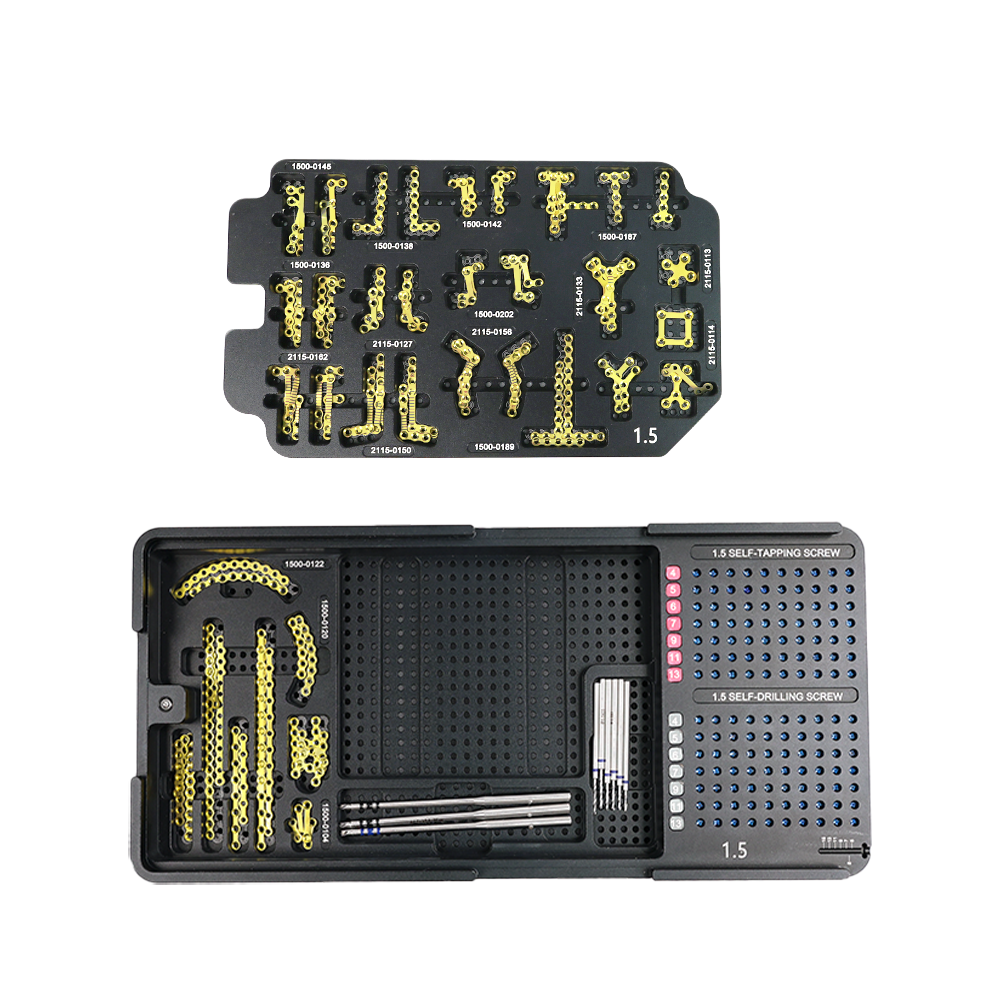
Maxillofacial micro plate Product Overviewchan
The Maxillofacial Micro Plate Set is a comprehensive titanium fixation system designed for delicate craniofacial trauma and reconstruction. Featuring 0.6mm thick pure titanium plates and Φ1.5mm titanium alloy screws, this set is ideal for frontal, nasal, orbital, zygomatic, maxillary, and pediatric craniofacial bone fixation.
Product Features
-
01 Combination Holes
A hole with both a traditional power pressurised section and a locking threaded section, providing flexibility.
-
02 Pure Locking Holes
Only locking screws can be screwed in.
-
03 Pure Pressurised Holes
Pressurisation can be achieved by eccentric screwing in of screws (relatively rare in microsystems).
-
04 Low Cutout
Smooth plate with rounded edges and screw heads countersunk in the plate, minimising the risk of soft tissue irritation and exposure.
Key Advantages and Design Details
The 0.6mm micro plate represents the lowest-profile option in the maxillofacial fixation range. It is manufactured from specially customized German ZAPP pure titanium, selected for its uniform grain size distribution, excellent biocompatibility, and non-magnetic behavior. Because the material does not interfere with MRI or CT imaging, postoperative surveillance remains artifact-free—a critical consideration in both trauma follow-up and oncological assessment.
Surface anodizing serves a dual clinical purpose. It increases surface hardness and wear resistance, and it produces the color coding that distinguishes plate thicknesses at a glance. The 0.6mm series is marked in amaranth (rose red), allowing surgeons and scrub staff to confirm plate selection instantly without calipers or additional verification.
Plate holes feature a concave, sunken design, so the screw head seats flush with the plate surface rather than protruding above it. This creates tighter plate-screw integration and a lower overall incision profile, reducing soft tissue irritation and palpability—particularly important in regions with thin coverage. Plate edges are rounded for the same reason, minimizing stimulation to surrounding soft tissue.
The matching Φ1.5mm screws are machined from medical-grade titanium alloy using Swiss CNC longitudinal cutting lathes, ensuring optimal hardness and flexibility. Key design features include an innovative conical right-angle driver interface for optimal torque transmission, a sloped conical head for reliable self-holding during placement, a reinforced screw root to resist breakage under torque, and an anti-pull angle thread profile for dependable pullout strength. Special concentricity control ensures each screw advances smoothly and seats predictably.
Plate geometries cover the fracture patterns encountered in delicate craniofacial surgery: straight, straight bridge, arc, L-plate (90°/110°), X-plate, rectangular, T-plate, Y-plate, and double-Y configurations. Locking and non-locking fixation options are both available, and locking micro plates are reversible—they can be used on either side without orientation concerns.
Specifications
Parameter | Specification |
|---|
Plate thickness | 0.6mm |
Material | Pure titanium (German ZAPP) |
Screw diameter | Φ1.5mm |
Screw type | Self-drilling / Self-tapping / Locking |
Screw lengths | 4mm, 5mm, 6mm, 7mm, 8mm |
Matching drill bit | Φ1.1mm |
Screwdriver | SW0.5 cross head |
Plate shapes | Straight, straight bridge, arc, L-plate (90°/110°), X-plate, rectangular, T-plate, Y-plate, double-Y |
Color coding | Amaranth / rose red (0.6mm series) |
Reversible | Yes (locking series) |
Maxillofacial Micro Plate Set — FAQ | 0.6mm Titanium, 1.5mm Screws 1
What exactly is a maxillofacial micro plate set, and what does it include?
A maxillofacial micro plate set is a comprehensive internal fixation kit designed for skeletal stabilization in the craniofacial region. The 0.6mm variant typically includes:
- Micro plates in multiple anatomical configurations: straight, arc, L-shaped, X-shaped, rectangular, T-shaped, Y-shaped, and double-Y plates
- Φ1.5mm titanium alloy screws in self-drilling or self-tapping options, with lengths ranging from 4mm to 8mm
- Matching instrumentation: Φ1.1mm medical drill bits and SW0.5 cross-head screwdrivers
The system is color-coded through anodizing technology, allowing surgeons to distinguish plate thicknesses at a glance—a subtle but significant intraoperative advantage.
2
Why choose 0.6mm thickness for craniofacial fixation?
The 0.6mm plate thickness is specifically indicated for frontal, nasal, orbital, zygomatic, maxillary, and pediatric craniofacial bone applications. Its ultra-low profile offers three distinct clinical benefits:
- Minimal soft tissue irritation: The thin design reduces palpability and discomfort, particularly important in areas with thin soft tissue coverage
- Pediatric suitability: Growing craniofacial bones require fixation that does not impede development; 0.6mm plates provide adequate stability without excessive bulk
- Precise adaptation: The thinner profile allows easier contouring to complex anatomical surfaces
Combined with concave hole design, the plate and screw integrate more tightly, creating a lower incision profile that further minimizes postoperative complications.
3
What are the advantages of Φ1.5mm screws in this system?
The Φ1.5mm screws are manufactured from imported medical-grade titanium alloy using Swiss CNC longitudinal cutting lathes, ensuring optimal hardness and flexibility. Key design features include:
- Innovative conical right-angle driver design: Ensures optimal moment and easy screw insertion
- Slope conical head design: Provides reliable self-hold appearance, preventing screw drop during placement
- Reinforced screw root: Effectively prevents screw breakage under torque
- Anti-pull angle thread design: Guarantees pullout strength and fixation stability
- Special concentricity control: Ensures smooth, effortless screwing
For locking micro plates, the Φ1.5mm locking screws will not loosen, guaranteeing stable fixation even in osteoporotic bone.
4
Is this system compatible with MRI and CT imaging?
Yes. The plates are manufactured from specially customized German ZAPP pure titanium, which offers excellent biocompatibility and uniform grain size distribution. Crucially, this material does not affect MRI or CT examination, allowing postoperative imaging without artifact interference—a critical consideration for oncological follow-up and trauma assessment.
The anodizing surface treatment further enhances material hardness and wear resistance while providing the color-coding system that facilitates clinical operation.
5
What is the difference between self-drilling and self-tapping screws in this set?
Both screw types are available in Φ1.5mm diameter, but they serve different clinical scenarios:
- Self-drilling screws: Feature a sharp tip that cuts directly into bone without a pilot hole, reducing surgical steps and operative time. Ideal for stable cortical bone.
- Self-tapping screws: Require a pilot hole (Φ1.1mm drill bit) and create threads as they are inserted. Preferred in denser bone or when maximum thread engagement is desired.
Both types share the same SW0.5 cross-head screwdriver, and for locking plates, a dedicated locking screw option provides angular stability and prevents loosening.
6
What clinical indications are best suited for this micro plate set?
The maxillofacial micro plate set (0.6mm/1.5mm) is indicated for:
- Frontal part fractures: Low-profile fixation in the forehead region
- Nasal part fractures: Precise stabilization of nasal bones
- Pars orbitalis (orbital region): Including orbital floor reconstruction when combined with anatomical orbital floor plates
- Pars zygomatica (zygomatic region): Cheekbone fixation
- Maxilla region: Upper jaw stabilization
- Pediatric craniofacial bone: The ultra-thin design is particularly advantageous in pediatric patients where bone growth is a concern
The reversible locking design (available in locking micro plates) allows the same plate to be used on either side, reducing inventory requirements while maintaining surgical flexibility.