



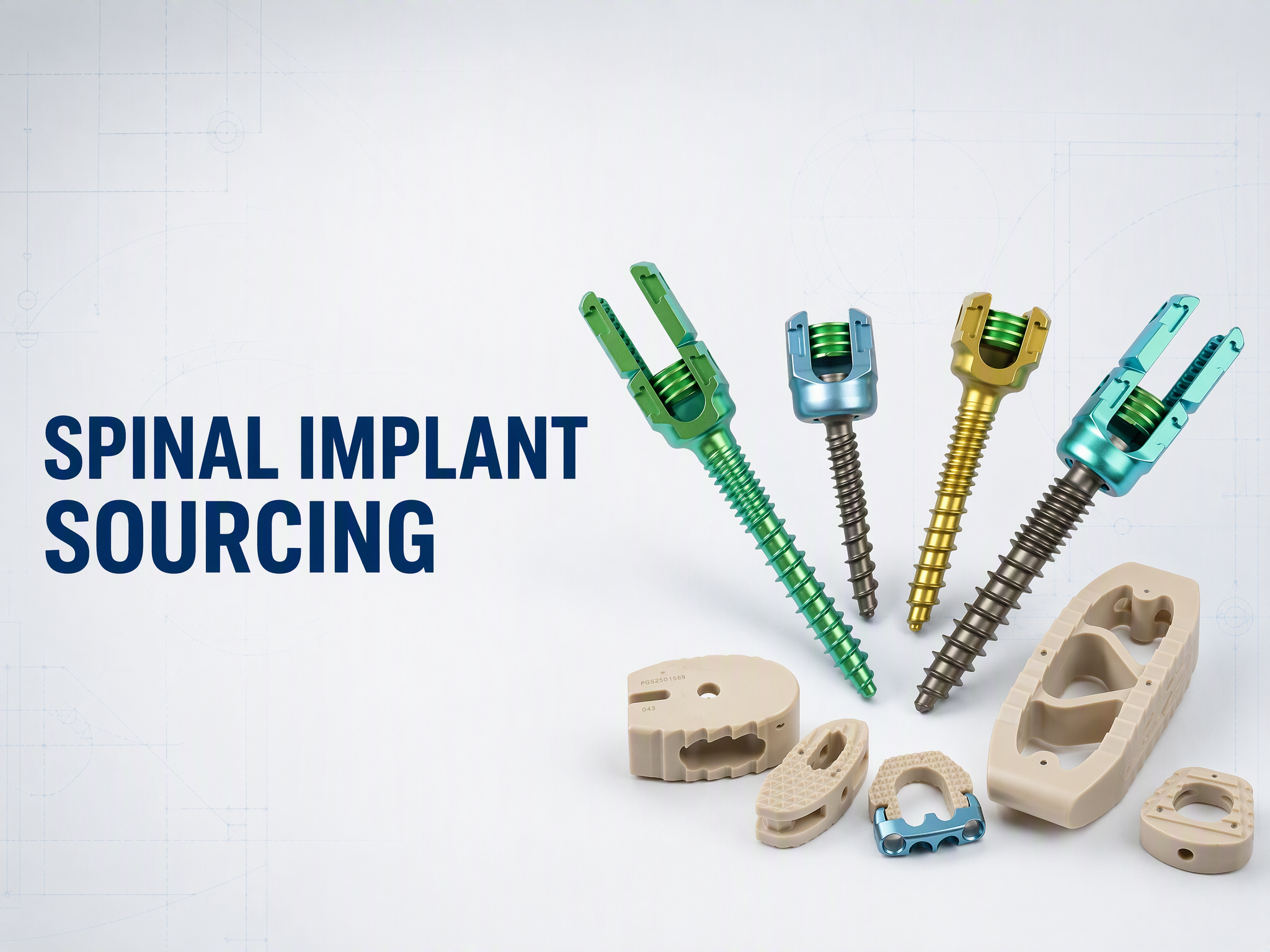
To choose a spinal implant manufacturer, evaluate the supplier against your target market, intended product portfolio, implant-instrument compatibility, quality-system evidence, product-specific regulatory documentation, and ability to support predictable supply. Compare documented capabilities, not marketing claims alone. Before committing, verify the exact products, configurations, certificates, responsibilities, and commercial terms that apply to your project.
Selecting a spinal implant supplier is a long-term business decision. A catalogue may show a broad product range, but it does not prove that every product is available for your market, supplied with the required instruments, or covered by the same regulatory documents.
For distributors and importers, the goal is to find a partner whose documented scope fits the products you plan to register, sell, and support. Use the following criteria to structure supplier discussions and compare proposals on an equivalent basis.
1. Start with the Market and Product Segment
Before asking for a quotation, define the market and product categories you intend to evaluate. “Spinal implants” can include several distinct product groups, each with different technical, regulatory, training, inventory, and customer-support requirements.
Depending on local demand and your commercial strategy, a portfolio review may include:
Pedicle screw and rod systems for posterior fixation
Cervical fixation systems, such as anterior plates or posterior screw-rod systems
Interbody cages for procedures such as cervical fusion, TLIF, PLIF, or OLIF
Specialized systems, such as laminoplasty or interspinous fixation systems
The surgical instruments required to implant and remove the selected systems
Do not assume that a supplier's broad spine catalogue represents a coherent system for every procedure. Ask for a product-family list that identifies each product's intended use, configuration, model or catalogue number, available versions, and corresponding instruments. Confirm that the supplier's product claims and documents match the product version being quoted.
A practical first step is to make a shortlist of the product families you want to assess. Mark each as “required now,” “possible later,” or “not in scope.” This helps prevent a broad but unfocused evaluation from consuming time and makes it easier to compare suppliers that offer different portfolios.
2. Check System Compatibility, Not Just the Implant List
A spinal implant system may include implants, instruments, and accessories intended to work together. Confirm the exact relationship between the components before treating them as one system.
For example, request the manufacturer's configuration or compatibility information for the selected screws, rods, connectors, set screws, and instruments. Ask how the company identifies the compatible items and controls changes to those configurations. If you are considering multiple families or sizes, ask whether they use the same instruments or require separate instrument sets. Do not infer compatibility from similar names, appearance, or dimensions.
This check matters commercially as well as technically. Incompatible or missing instruments can create extra inventory needs, complicate training and field support, or delay product registration and launch planning. The supplier should be able to tell you what is included in the proposed system, what must be ordered separately, and which compatibility claims are documented.
Questions to Ask
Which implant components belong to the proposed system?
Which instruments are required for each configuration?
Are instruments shared across product families? If so, which ones?
How are compatible components identified in the catalogue and technical files?
What is the change-notification process if a component or instrument is revised?
If your market requires product-specific technical information, request the relevant documents for the exact catalogue numbers under consideration rather than a generic system brochure.
3. Review Quality-System Evidence and Certificate Scope
A quality certificate is useful evidence, but it is not a substitute for checking the certificate itself. Review the legal entity name, manufacturing site, issuing body, standard or scheme, effective and expiry dates, certificate status, and scope. The scope matters: it should be relevant to the activities and product families you are evaluating.
ISO 13485 is a quality-management-system standard for medical-device organizations; it is not a product approval or a market authorization. Certification to a standard should therefore be assessed alongside product-specific evidence and your destination market's rules. ISO describes ISO 13485 as a medical-device quality-management-system standard, while noting that regulatory requirements vary by country.
For due diligence, ask the manufacturer to provide current, controlled copies of applicable certificates and to explain which entity, site, and products they cover. You can also ask what quality records or processes are available for supplier qualification, such as incoming-material controls, inspection records, nonconformance handling, corrective actions, complaint handling, and change control. The level of detail you need will depend on your role and the local regulatory framework.
Treat broad phrases such as “internationally certified” as prompts for verification, not as evidence on their own. Make a note of any gaps between the certificate scope and the products in your proposed quotation.
4. Verify Regulatory Documents for the Exact Destination Market
Regulatory requirements differ by jurisdiction and product. A supplier should be able to identify what documents it can provide, what is product-specific, and what remains the importer's or distributor's responsibility. It should not suggest that one certificate automatically permits sale in every country.
For each target market, request a document list tied to the exact product family and model. Depending on the market and product, this may include declarations or certificates, product registration evidence, labeling information, technical documentation, and details needed for importer or distributor obligations. Ask the relevant local authority or regulatory professional to confirm which documents and steps are required for your situation.
Keep These Concepts Separate
ISO 13485 certification concerns a quality management system within the stated certificate scope.
CE marking and EU MDR status are product and conformity-assessment matters. The European Commission identifies distinct responsibilities for manufacturers, authorised representatives, importers, and distributors under the medical-device regulations.
FDA establishment registration or device listing is not the same as FDA approval, clearance, or authorization. FDA registration and listing entries do not by themselves denote approval or clearance of a facility or device.
An FDA export certificate is not a blanket authorization for your market. Export certificates have specific purposes and should be read together with the applicable product and market requirements.
For a U.S. project, independently verify the applicable regulatory pathway and product status using FDA information relevant to the device. For an EU project, check the exact product's conformity documentation, certificate scope where applicable, and the obligations of each economic operator. Do not rely only on a supplier's statement that it is “FDA registered” or “CE certified.”
5. Assess Technical-File Readiness and Product Traceability
A reliable supplier discussion should move from general capability claims to specific documents and records. Ask what technical and quality information is available for the products you are evaluating and how the manufacturer maintains identification and traceability through its process.
Your request may include:
Product catalogue and model/configuration list
Product descriptions, drawings, and specifications
Material identification and applicable material documentation
Packaging, labeling, and sterilization information, where relevant
Inspection and release documentation available for the product
Lot or batch identification and traceability information
Change-control and complaint-handling processes
Current certificates and product-specific regulatory documents
Not every buyer will need every record at the initial screening stage. Agree on the level and timing of documentation needed for supplier qualification, registration, importation, and ongoing monitoring. If a document is confidential or cannot be shared until a formal project stage, ask what evidence can be provided earlier and under what conditions.
Make sure the documents correspond to the exact products being quoted. Names, model numbers, configurations, manufacturing sites, and certificate scopes should be consistent across the quotation and supporting files. If a model or product family is listed ambiguously, request written clarification before you use that information in a registration application or commercial commitment.
6. Evaluate Manufacturing and Supply Capability with Evidence
A manufacturer should be able to explain how its production and quality processes support the products in your scope. Instead of relying on broad claims about equipment or capacity, ask questions that connect capability to your actual demand.
Examples include:
Which operations are performed at the listed manufacturing site?
Which processes are outsourced, and how are external providers controlled?
How are revisions and nonconforming products managed?
What lead-time assumptions apply to initial orders and repeat orders?
Which components are standard, and which require project-specific planning?
How does the supplier manage shortages, quality issues, or a change in production status?
Where appropriate, ask whether a site audit, remote audit, or document-based supplier assessment is possible. Define the questions, audit scope, and required evidence in advance. The aim is not to obtain a generic “capacity” statement; it is to understand whether the supplier can support your planned range, forecast, and replenishment model.
7. Compare Total Supply Requirements, Not Unit Price Alone
A lower unit price does not necessarily mean a lower cost to serve your market. Compare quotations that use the same products, configurations, instruments, packaging assumptions, order quantities, delivery terms, and documentation expectations.
Consider the full sourcing picture:
Comparison area | What to clarify |
|---|---|
Product scope | Exact models, configurations, instruments, and included accessories |
Order assumptions | Minimum order quantities, forecast needs, and repeat-order terms |
Delivery | Lead-time assumptions, shipping terms, and handling of delays |
Documentation | What is included, what requires additional work, and timing |
Launch support | Training materials, product information, and technical communication |
Project changes | How design, labeling, or packaging changes are quoted and approved |
A quotation is easier to evaluate when the supplier itemizes assumptions. Ask for separate pricing or scope notes where an instrument set, custom packaging, private label, or additional documentation may change the project cost.
8. Define OEM/ODM Responsibilities Before Development Starts
OEM and ODM projects can involve product selection, customization, labeling, packaging, documentation, and regulatory planning. The commercial label alone does not establish who owns each responsibility.
Before starting a project, document:
Which party owns the product design and existing intellectual property
Which specifications may be changed and who approves changes
Who is responsible for validation, verification, and regulatory submissions
What product and process records each party will maintain
How confidentiality, tooling, samples, and project data will be handled
Who approves labels, packaging, and claims for the target market
How minimum order quantities, development costs, and timing will be agreed
For a project with an existing design, provide a clear specification package and acceptance criteria. If the supplier is expected to contribute design or engineering input, define the scope and decision-making process before prototypes or production tooling are commissioned.
9. Use a Consistent Supplier Scorecard
A simple scorecard helps your team compare suppliers against the same requirements. Rate each category as “meets,” “partially meets,” “not demonstrated,” or “not applicable,” and keep supporting evidence alongside the score.
Evaluation category | Evidence to record |
|---|---|
Portfolio fit | Product families and configurations that match the target market plan |
System compatibility | Documented implant, instrument, and accessory relationships |
Quality system | Current certificate, site, scope, and expiry verification |
Regulatory readiness | Product-specific documentation for the intended market |
Technical support | Clarity and completeness of technical responses |
Supply model | Lead-time assumptions, replenishment, and change communication |
Commercial fit | Comparable quotation scope and project terms |
OEM/ODM fit | Defined ownership, responsibilities, and development process |
A “not demonstrated” score should trigger a follow-up request, not an assumption that a supplier lacks the capability. Conversely, do not score a capability as proven based solely on a sales presentation or website statement.
10. Common Mistakes to Avoid
Choosing by catalogue breadth alone. A large product list does not establish that the relevant systems, instruments, and documents are available for your market.
Treating a company certificate as product approval. Check what the certificate covers and separately verify product-specific market status. This is especially important when documents use phrases such as “FDA registered” or “CE certified.”
Assuming instruments are interchangeable. Confirm compatibility in writing for the exact systems and models being evaluated.
Comparing non-equivalent quotations. Align configurations, instruments, packaging, quantities, shipping assumptions, and documentation before comparing price.
Leaving regulatory planning until after selection. Identify target-market requirements early, then confirm the supplier's product-specific files can support the intended process.
11. How Geasure Medical Fits a Spine-Supplier Review
Geasure Medical's spine portfolio includes posterior screw-rod systems, cervical fixation products, laminoplasty products, and interbody cages for cervical and lumbar procedures. Its product materials also list spinal surgical instruments. This range may be relevant to distributors assessing whether a supplier can support several related spine categories, but buyers should confirm each product's exact configuration, instrument compatibility, availability, and market documentation directly with the company.
The MDSAP certificate available for review lists a scope covering design, manufacture, and distribution of pedicle screw systems, PEEK cage systems, anterior cervical plate systems, and related instruments among other orthopedic products. The certificate states an effective date of September 5, 2025, and expiry date of September 4, 2028. Before relying on this information, request the current certificate and verify that the scope and listed site match the products in your project.
You can review Geasure's Spine System portfolio, Spine Implant products, and Spine Instruments. For certificates and conformity documents, consult the Certifications page and request current, product-specific documentation.
Conclusion
Choosing a spinal implant manufacturer is a structured verification process. Start with your destination market and intended portfolio, then confirm implant-instrument compatibility, certificate scope, product-level documents, traceability, supply assumptions, and OEM/ODM responsibilities. Compare suppliers using the same checklist and request written evidence for every capability that affects your launch or ongoing supply.
Planning a spine product evaluation? Explore Geasure Medical's spine systems and contact the team to request the relevant product catalogue, instrument information, and current documentation for your target market.
Frequently Asked Questions
What should I check first when choosing a spinal implant manufacturer?
Start with your target market, required product categories, and product-specific regulatory needs. Then verify the manufacturer's system configurations, instrument compatibility, quality certificate scope, supply assumptions, and technical documentation.
Does ISO 13485 certification mean a spinal implant is approved for sale?
No. ISO 13485 concerns a quality management system within the certificate's stated scope. Product authorization or conformity requirements depend on the destination market and the specific device.
Is FDA registration the same as FDA approval or clearance?
No. FDA establishment registration and device listing do not by themselves mean a device has been approved, cleared, or authorized. Check the applicable pathway and product status using FDA information relevant to the device.
Should spinal implants and surgical instruments be sourced from the same manufacturer?
There is no universal requirement that they must come from the same supplier. If buying them together, confirm documented compatibility and availability. If sourcing separately, establish who verifies compatibility, maintains the required documentation, and supports the system configuration.
What documents should I request from a spinal implant supplier?
Begin with the product catalogue and model list, relevant certificates and scopes, product-specific regulatory files for your market, technical specifications, material information, packaging and sterilization details where applicable, and traceability information. Your final document list should be checked against local requirements.

