
 EN
EN



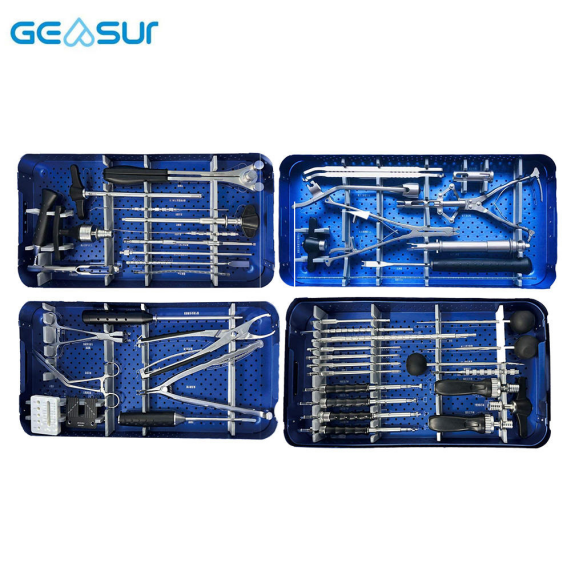
Micron-Level Precision: Mechanical Logic and Clinical Application of the Geasure Instruments Set for Spinal Surgery
In spinal surgery, a variance of a single millimeter represents the threshold between optimal decompression and permanent neurological deficits. As operational methodologies transition toward Minimally Invasive Surgery (MIS) and long-construct deformity corrections, the mechanical burden placed on surgical hardware has escalated significantly.
To address these demanding clinical requirements, advanced manufacturing systems have developed comprehensive solutions like the geasure instruments set for spinal surgery. By analyzing metallurgical properties, ergonomic geometry, and specialized component interfaces within posterior fixation and percutaneous systems, we can evaluate how specific engineering choices translate to reproducible safety in the operating room.
Ergonomic Geometry and Proprioceptive Feedback
For an experienced spine surgeon, an instrument functions as an extension of their tactile perception rather than a mere tool. During procedures like a Transforaminal Lumbar Interbody Fusion (TLIF), direct visualization of deep anatomical structures is often limited; the operator must rely entirely on the subtle vibrations and resistance transmitted through the handle to differentiate between cortical bone, cancellous bone, the ligamentum flavum, and nerve roots.
Clinical Case Study: Mitigating Fatigue in a Reconstructive L4-S1 Revision
Clinical Scenario: A 64-year-old male presented with severe adjacent segment disease (ASD) accompanied by high-grade canal stenosis. The surgical revision plan required extending a previous fusion construct cephalad to L3, necessitating the removal of highly sclerotic, hypertrophied lamina and extensive epidural scar tissue.Operational Challenge: In multi-level revisions, sustained grip force against dense tissue accelerates forearm muscle fatigue, which directly correlates with micro-tremors during critical phases like neural isolation and decompression.Instrument Deployment: Utilizing the geasure instruments set for spinal surgery during the decompression phase altered the ergonomics of the procedure. The knurled, slip-resistant handle geometry minimized the required gripping tension. Crucially, the instrument’s center of mass is balanced toward the proximal palm rather than the working tip, relieving wrist torque during awkward angles. When resecting sclerotic bone, the smooth dual-spring return mechanism on the rongeurs provided clean bone cleavage without a sudden "breakthrough plunge," safeguarding the underlying dura.
Sub-System Rigidity and Kinematic Efficiency
Modern spinal reconstruction rejects a "one-size-fits-all" approach to instrumentation. The architecture of the set is organized into modular sub-systems designed to match specific implant configurations and surgical approaches:
The 5.5mm / 6.0mm Posterior Fixation Sub-System
For rigid stabilization in degenerative and deformity corrections, the instruments must deliver high torque without micro-torsional slippage:
-
Coaxial Stabilization Technology: The pedicle screw drivers feature a rigid outer locking sleeve that locks the implant head along the exact central axis of the driver shaft. This eliminates toggling or spatial divergence when driving large-diameter screws into dense pedicles, ensuring the implant follows the path mapped by the probe.
-
Mechanical Advantage Reducers: For three-dimensional deformity corrections, the system’s rod persuaders utilize a highly calculated thread pitch. This converts high anatomical resistance into controlled, linear, millimeter-by-millimeter rod reduction into the screw heads without risking screw pull-out.
Minimally Invasive Percutaneous Systems (MIS)
In percutaneous environments, surgeons operate through narrow corridors with compromised direct sightlines, relying heavily on fluoroscopy or navigation:
-
Low-Profile Silhouette: Inserters and counter-torque wrenches feature a streamlined profile that maximizes the visible field under the surgical microscope or loupes, preventing instruments from crowding and colliding in the wound.
-
Sub-Fascial Arc Guidance: Percutaneous rod inserters are machined with a fixed geometric radius. This allows the stabilizing rod to slide through deep fascial planes and muscle groups along a trajectory matching the sagittal lumbar lordosis, minimizing paraspinal muscle stripping.
Metallurgy and Manufacturing Consistency
The reliability of a surgical instrument set under operational stress depends heavily on its material science. Components must tolerate extreme torsional loads while enduring hundreds of high-temperature autoclave sterilization cycles without experiencing micro-structural embrittlement or surface corrosion.
Advanced Material Matrix
| Component Type | Material Base | Key Structural Property | Clinical Utility |
| Pedicle Taps & Probes | High-Tensile Stainless Steel ($X30Cr13$) | High yield strength and torsional limits; zero flex | Prevents driver shearing or thread deformation within narrow pedicle isthmuses. |
| MIS Percutaneous Sleeves | Medical-Grade Titanium ($Ti-6Al-4V$) | Exceptional strength-to-weight ratio; low density | Minimizes the lateral weight drag placed on soft paraspinal tissue beds. |
| Rongeurs & Cutting Tips | Hardened Steel + Titanium Nitride (TiN) | High edge retention and friction resistance ($HRC\ 50-55$) | Sustains precise bone cutting, eliminating bone crushing and micro-fractures. |
Manufacturing Tolerances and Sterility
Instruments are processed using high-precision five-axis CNC machining to hold geometric tolerances within tight micron ranges. This consistency ensures that the driver interface fits perfectly into the set screw every time, eliminating the risk of cam-out or stripping that can stall an operation.
Furthermore, advanced electrochemical passivation finishes eliminate micro-porosity on the metal surfaces. During automated post-operative washing, enzymatic solutions can thoroughly clear blood, proteins, and bio-burden, ensuring long-term sterility and safety.
Biomechanical Consensus and Safety Frameworks
The mechanical choices behind modern spinal instrumentation designs are strongly supported by a broad body of orthopedic and neurosurgical literature:
-
Screw Placement Accuracy: Data published in The Journal of Bone and Joint Surgery (JBJS) indicates that pedicle screw malposition rates can range up to 15-20% when using loose-fitting driver interfaces that allow axial toggle. Utilizing a stabilized, coaxially locked system—like the one within the geasure instruments set for spinal surgery—substantially mitigates the "wandering effect" at the cortical entry point.
-
Reduction of Neural Complications: Clinical safety guidelines from the North American Spine Society (NASS) emphasize that instrument sharpness and ergonomic control correlate directly with a reduction in unintended dural tears and nerve injuries during decompression. When cutting tools retain their edge, surgeons apply less linear force, preventing sudden, uncontrolled plunging into the spinal canal when traversing the ventral cortex of the lamina.
By coupling high torsional strength with clean proprioceptive feedback, the geasure instruments set for spinal surgery addresses the core requirements of modern spine surgery: absolute control for the surgeon, protection for the patient’s neural structures, and predictable outcomes across variable patient anatomies.