
 EN
EN



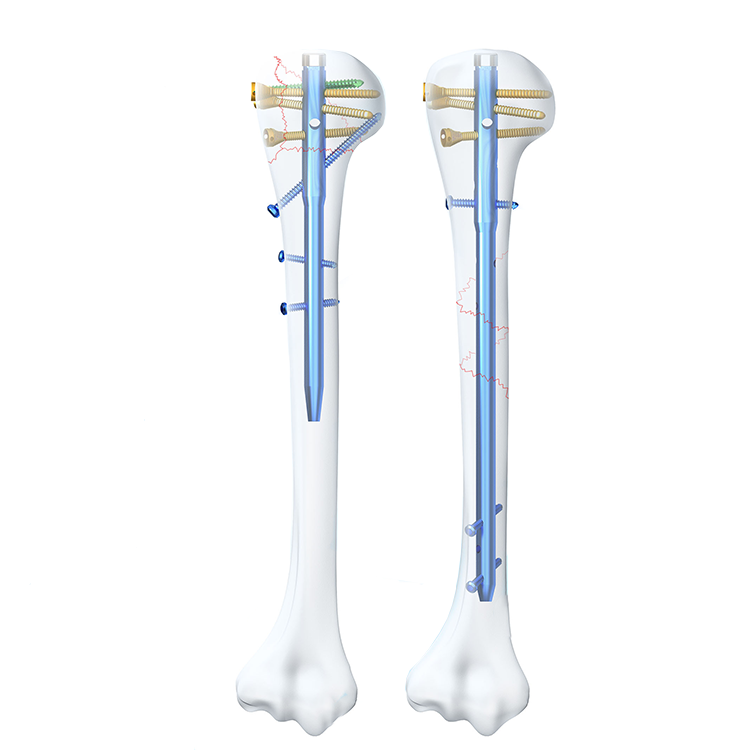
Humeral shaft fractures account for approximately 1–3% of all adult fractures and occur across a wide spectrum of patients—from young adults sustaining high-energy trauma to elderly individuals with low-energy falls through osteoporotic bone. Treatment must balance fracture stability with protection of the radial nerve, which winds around the humeral shaft. Among available fixation methods, humeral intramedullary nails have emerged as a reliable, minimally invasive solution that provides excellent biomechanical stability while respecting the soft-tissue envelope.
At Geasure Medical (Changzhou Geasure Medical Apparatus and Instruments Co., Ltd.), we have developed a comprehensive humeral nail system designed for simple and complex humeral fractures. Manufactured from medical-grade titanium alloy in our ISO 13485 and CE MDR-certified facility, Geasure humeral nails offer optimal nail geometry, flexible locking options, and superior fatigue resistance—enabling surgeons to treat humeral fractures with confidence and patients to return to upper extremity function as quickly as possible.
The Challenge of Humerus Fracture Treatment
The humerus is unique among long bones because it is not weight-bearing but requires significant rotational stability for arm function. Unlike the lower extremity, where immediate full weight-bearing is desired, the upper extremity demands early mobility without excessive load. Fracture fixation must resist torsional forces (rotation from shoulder and elbow muscles) and bending forces from arm weight and pendulum exercises.
Key Treatment Goals:
-
Anatomic or near-anatomic alignment
-
Preservation of radial nerve function
-
Early shoulder and elbow range of motion
-
High union rates with low implant-related complications
Humeral nails address these goals by providing a load-sharing intramedullary construct that neutralizes bending and rotational forces, allowing early functional rehabilitation.
Design Features of Geasure Humeral Nails
Geasure humeral nails are engineered with specific anatomical and biomechanical considerations for the humerus.
Nail Geometry and Entry Point
-
Straight nail design with a proximal lateral bend to accommodate the natural curvature of the proximal humerus and facilitate insertion through a small supraspinatus-splitting incision.
-
Cannulated design (3.0–3.5 mm) allows insertion over a guidewire, ensuring accurate alignment and reducing malreduction risk.
-
Diameter options (7.0 mm, 8.0 mm, 9.0 mm) and lengths (150–300 mm) to fit various patient sizes and fracture patterns.
Proximal Locking Configuration
-
Multi-directional locking holes (oblique, transverse) in the proximal fragment to capture the humeral head while avoiding the critical zone of the radial nerve.
-
Spiral blade or helical locking option (depending on system version) provides enhanced rotational stability in osteoporotic bone—similar to PFNA principles but adapted for the humeral head.
Distal Locking System
-
Static or dynamic locking via two distal screws placed perpendicular or oblique to avoid the radial nerve. Geasure’s instrument set includes radiolucent aiming arms that simplify distal targeting under fluoroscopy.
-
Screw hole spacing optimized for short or long segment fractures.
Surface Treatment
Geasure humeral nails undergo controlled anodization and passivation to create a uniform oxide layer, enhancing corrosion resistance and biocompatibility. The smooth surface reduces friction during insertion and minimizes metal ion release.
Material and Manufacturing Excellence
The demanding biomechanical environment of the humerus—especially in active patients or those with delayed union—requires an implant with high fatigue strength.
Ti6Al4V ELI Titanium Alloy
Geasure humeral nails are machined from titanium alloy conforming to ASTM F136 and ISO 5832-3. Benefits include:
-
High strength-to-weight ratio
-
Excellent corrosion resistance and biocompatibility
-
MRI compatibility with minimal artifact
-
Fatigue resistance suited for upper extremity loading cycles
Precision CNC Machining
Using multi-axis CNC centers, Geasure produces humeral nails with:
-
Tight dimensional tolerances (±0.02 mm)
-
Consistent locking hole geometry for perfect screw fit
-
Smooth internal cannulation for effortless guidewire passage
Cleanroom Manufacturing
Final cleaning and packaging are performed in a controlled environment, ensuring implants are free from particulates and ready for sterilization.
Mechanical Testing and Quality Assurance
Every Geasure humeral nail system undergoes rigorous testing to validate its clinical reliability.
Static Testing
-
Four-point bending per ASTM F1264 to verify yield strength and bending stiffness.
-
Torsional testing to measure rotational stability of the nail-locking screw construct.
Fatigue Testing
Geasure humeral nails are subjected to cyclic axial and torsional loading exceeding 5 million cycles at physiologically relevant loads (e.g., 200–300 N for upper extremity), confirming long-term fatigue resistance.
Locking Screw Pull-Out Testing
The locking screws are tested for pull-out strength and stripping torque, ensuring reliable intraoperative performance.
Quality System
Geasure holds ISO 13485, ISO 9001, and CE MDR certifications. Each humeral nail is fully traceable from raw material melt record to final release.
Clinical Benefits for Patients
The design and manufacturing quality of Geasure humeral nails translate directly into improved patient outcomes.
Minimally Invasive Insertion
A small incision over the proximal humerus and insertion without extensive soft-tissue stripping preserves the fracture hematoma and reduces postoperative pain.
Early Rehabilitation
Because humeral nails provide immediate stability, patients can begin passive and active range-of-motion exercises within days of surgery. This is critical for preventing shoulder stiffness (frozen shoulder) and elbow contractures—common complications after humeral fractures.
High Union Rates
Load-sharing intramedullary fixation promotes secondary bone healing with abundant callus formation. Clinical evidence supports union rates exceeding 90% for humeral shaft fractures treated with nails.
Low Radial Nerve Risk
Compared to plate fixation, which requires direct exposure of the radial nerve, nailing is performed through a remote approach, significantly reducing the risk of iatrogenic nerve injury.
Suitable for Polytrauma and Elderly Patients
For polytrauma patients, humeral nailing can be performed quickly with minimal blood loss. For elderly patients with osteoporotic bone, the nail’s intramedullary position and multiple locking options provide secure fixation resistant to cut-out.
Expert Perspective:
“Humeral shaft fractures can be surprisingly challenging. The radial nerve is at risk, and the arm demands early motion to avoid stiffness. A well-designed humeral nail—with proper proximal locking, a smooth surface, and reliable distal targeting—makes the surgery safer and the recovery faster. Geasure’s humeral nail system delivers exactly that combination of biomechanical soundness and intraoperative ease.”
Comprehensive Instrumentation and Surgical Support
Geasure provides a complete humeral nail instrument set, including:
-
Entry awl and reamers for preparation of the proximal humerus
-
Guidewire and cannulated insertion handle
-
Radiolucent distal aiming arm for accurate locking under C-arm guidance
-
Depth gauge, screwdrivers, and extraction tools
All instruments are manufactured with the same precision as the implants, ensuring seamless compatibility and long-lasting durability.
OEM/ODM Capabilities and Global Reach
Geasure serves as a trusted OEM/ODM partner for distributors and orthopedic brands worldwide. For humeral nails, we offer:
-
Custom nail diameters, lengths, and locking configurations
-
Private-label packaging and labeling
-
Complete instrument set design and production
-
Regulatory documentation support (CE, ISO, FDA)
With ISO 13485 and CE MDR certifications, Geasure humeral nails are eligible for tender submissions in Europe, Asia, the Middle East, and Latin America.
Conclusion: A Reliable Foundation for Upper Extremity Recovery
Humeral fractures require a fixation solution that balances stability, safety, and early mobility. Geasure humeral nails—engineered from high-strength titanium alloy, precision-machined, rigorously tested, and supported by complete instrumentation—provide surgeons with a reliable tool to achieve these goals. For patients, a Geasure humeral nail means less postoperative pain, faster return of arm function, and a lower risk of complications.
Table of Contents
- The Challenge of Humerus Fracture Treatment
- Design Features of Geasure Humeral Nails
- Material and Manufacturing Excellence
- Mechanical Testing and Quality Assurance
- Clinical Benefits for Patients
- Comprehensive Instrumentation and Surgical Support
- OEM/ODM Capabilities and Global Reach
- Conclusion: A Reliable Foundation for Upper Extremity Recovery