
 EN
EN



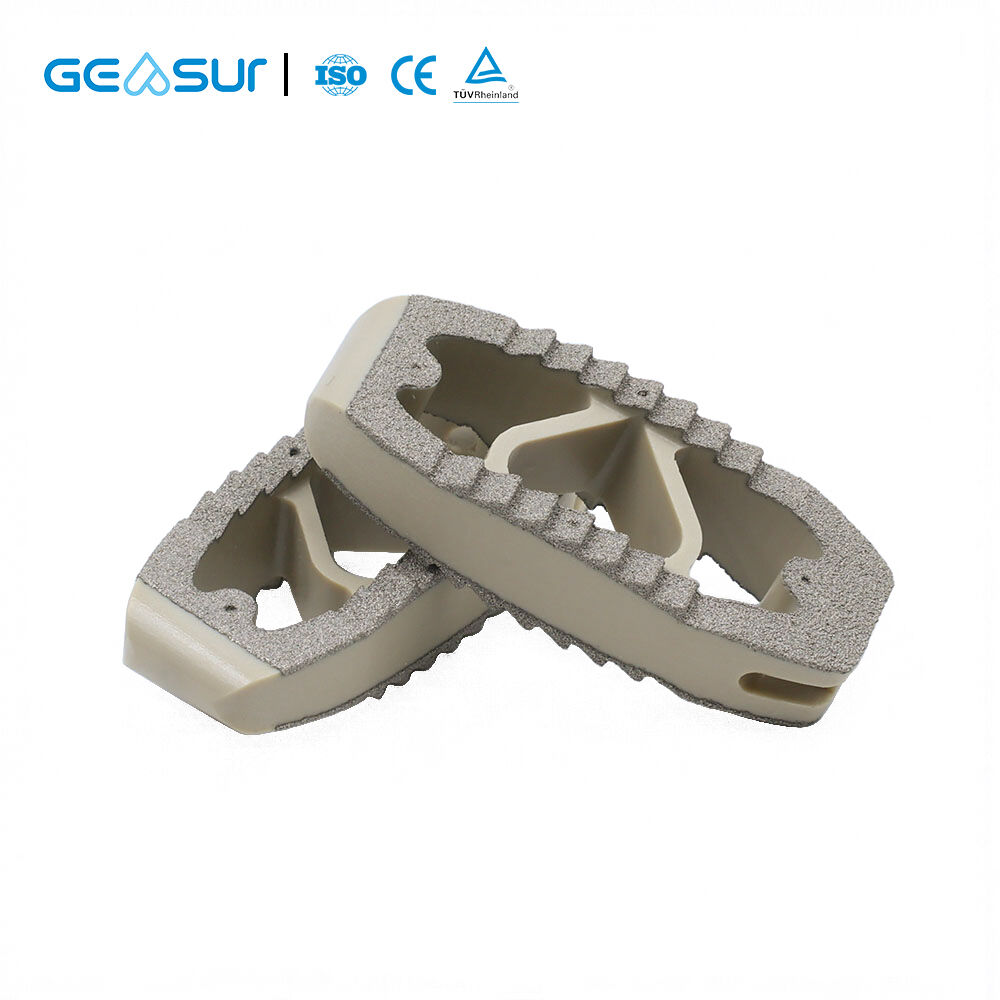
Geasure Titanium-Coated PEEK Fusion Cages: Addressing Clinical Needs in Lumbar Fusion Surgery
I. Introduction: From Clinical Pain Points to Solutions — Responding to Practical Needs in Lumbar Fusion Surgery
1. Concrete Clinical Dilemmas
- Some patients with lumbar spondylolisthesis may face adjacent segment bone changes related to traditional metal fusion cages after surgery, while pure PEEK fusion cages may require longer immobilization time in the osseointegration process;
- Some patients with lumbar disc herniation may have their fusion effect assessment affected by metal artifacts during postoperative MRI re-examination.
These scenarios reflect the room for improvement of traditional fusion cages in mechanical compatibility, fusion efficiency and imaging compatibility.
2. Necessity of Technological Exploration
The goal of lumbar fusion surgery is to achieve bony fusion, restore spinal stability and support patients' long-term quality of life. As a core implant, the material selection and structural design of the fusion cage have an important impact on surgical outcomes. The research and development of titanium-coated PEEK fusion cages aims to address the shortcomings of traditional instruments and improve mechanical compatibility, osseointegration support and imaging compatibility to meet practical clinical needs.
3. Geasure Medical's Role Positioning
As a collaborative partner of clinicians and a concerned party for patients' health, Geasure Medical has integrated titanium-coated PEEK fusion cages into its spinal solution system. From R&D to service links, all efforts are focused on solving practical clinical problems, striving to make technological innovation better land in clinical application scenarios.
II. Geasure Medical: A "Clinically-Oriented" Enterprise Deeply Engaged in the Spinal Field
1. Corporate Gene: Centered on "Clinical Demand-Driven R&D"
"Clinical Binding" of R&D System
- Establish cooperative mechanisms related to spinal implants with many medical institutions at home and abroad,
- Invite clinical orthopedic professionals to participate in product R&D consulting,
- Collect a certain number of clinical demand feedback in the early stage of each product's R&D to ensure that the technical direction is in line with practical application scenarios.
Case: The anti-slip tooth design of the titanium-coated PEEK fusion cage originated from clinical concerns about the postoperative stability of the fusion cage. The final structure was determined after multiple rounds of surgical simulation tests to adapt to the actual needs in surgical operations.
2. "Dual-Center" Model of Global Layout: Balance between Efficiency and Localization
Changzhou Headquarters
- Build a R&D and production base that meets industry standards,
- Equipped with corresponding injection molding workshops and coating laboratories,
- Realizing a coherent process of "R&D - Production - Testing", which helps shorten the cycle from R&D to application of technology.
Norway European Service Center
- Provide localized technical support and after-sales response services for the European and American markets,
- Assist regional customers in coping with regulatory adaptation and clinical training needs, such as supplementing technical documents required for relevant certifications for European customers.
3. Value Proposition Implementation: "Every Product Focuses on Clinical Safety"
Geasure Medical pays attention to quality control in the production link, sets strict quality audit standards, and handles products that do not meet the standards found in the production process accordingly to ensure that the products flowing to the clinic meet the established quality requirements.
III. Geasure's Differentiated Strengths: Building a "Full-Value Chain Guarantee System" for Spinal Fusion Instruments
(I) R&D: More Than "Technological Innovation", Focus on "Clinical Implementation"
1. R&D Closed Loop: Gradual Advancement from "Clinical Feedback" to "Product Optimization"
- Step 1: Collect common problems in clinical operations through cooperative medical institutions and surgical follow-up;
- Step 2: Organize material engineers, mechanical designers and clinical professionals to jointly demonstrate the feasibility of technical solutions;
- Step 3: Produce product prototypes and test the implantation effect on simulated spinal models;
- Step 4: Select some medical institutions for small-scale trial use and collect feedback from practical applications;
- Step 5: Iterate and adjust the product according to the trial feedback. For example, the size of the bone graft channel of the titanium-coated PEEK fusion cage has been optimized in combination with the convenience of clinical operations to adapt to the needs of bone graft operations.
2. "Clinical Compatibility" of Material Selection: Focus on "Safety and Practicality"
- Selection of Medical-Grade PEEK Substrate: Considering the mechanical characteristics of the lumbar spine, a PEEK substrate with elastic modulus similar to that of lumbar cortical bone is selected to reduce potential problems in mechanical compatibility;
- Titanium Coating Process: Adopt low-temperature plasma spraying technology to avoid the impact of high temperature on the PEEK substrate, and at the same time control the coating porosity and adhesion to support the basic needs of osteocyte adhesion. The coating performance meets relevant industry standards.
(II) Production: "Dual Guarantee" of Intelligence and Flexibility
1. Data-Driven Quality Consistency: Introduce a Manufacturing Execution System (MES) to record and monitor key parameters in the production process of fusion cages
- Injection Molding Link: Real-time monitoring of temperature, pressure and other parameters to reduce dimensional deviations caused by parameter fluctuations;
- Coating Link: Inspect the coating thickness through a visual inspection system to ensure the stability of coating quality.
2. Flexible Production Capacity: Balancing "Large-Scale" and "Customized" Needs
- Large-Scale: Possess the production capacity of standardized fusion cages to meet the needs of global conventional orders;
- Customized: Provide customized production services within a certain range for some special cases (such as vertebral deformity, bone defect), such as adjusting the bone graft channel design of the fusion cage for specific revision surgery needs.
(III) Quality Control: "Dual Defense Line" of "Enterprise Self-Inspection + Third-Party Inspection"
1. Enterprise Self-Inspection: Establish a multi-link inspection process covering key links from raw materials to finished products
- Raw Material Inspection: Conduct purity analysis on PEEK substrates and heavy metal content detection on titanium powder to ensure that raw materials meet medical standards;
- Finished Product Inspection: In addition to routine mechanical performance and sterility tests, stability tests simulating the in vivo environment are also conducted to evaluate the potential performance of products in in vivo applications.
2. Third-Party Inspection: Cooperate with international authoritative testing institutions to conduct regular sampling inspections on products. The test results can be provided according to customer needs to enhance the transparency of product quality.
(IV) Compliance: Focus on "Certification Pass" and "Regional Regulatory Adaptation"
1. Comprehensive Certification Coverage
Has obtained relevant certifications such as FDA 510(k) (K223776), CE MDR, and ISO 13485, meeting the basic international medical device compliance requirements;
2. Regional Compliance Services: Provide support for regulatory differences in different markets
- EU Market: Assist customers in updating clinical evaluation reports under the MDR system and provide data support meeting IVDR requirements;
- US Market: Provide customers with data templates required for FDA post-marketing surveillance and assist in completing adverse event reporting processes.
IV. Titanium-Coated PEEK Lumbar Fusion Cages: Adaptive Solutions for "Different Subjects"
(I) For Patients: Design Considerations Focused on "Safety and Rehabilitation Process"
- Reduce Postoperative Potential Risks: The biocompatibility of the product meets ISO 10993 standards, helping to reduce the probability of postoperative rejection;
- Support Rehabilitation Process: The titanium coating design helps provide certain support for osseointegration, which may have a positive effect on shortening the rehabilitation cycle and helping patients gradually restore normal activities;
- Long-Term Application Considerations: By optimizing mechanical compatibility, it helps reduce the risk of long-term adjacent segment changes caused by stress problems, providing support for patients' long-term spinal health.
(II) For Doctors: Instrument Design Focused on "Operational Convenience and Evaluation Accuracy"
- Adapt to Different Surgical Scenarios: Provide a variety of specifications of fusion cages covering most segments of L1-L5, which can adapt to common surgical approaches such as TLIF and PLIF;
- Operational Convenience: The anti-slip tooth design helps reduce the possibility of postoperative displacement of the fusion cage and reduce additional fixation operations; the smooth product surface helps reduce soft tissue damage and provides convenience for surgical operations;
- Convenience of Postoperative Evaluation: The radiolucent characteristics of PEEK materials will not cause obvious interference to postoperative CT/MRI imaging, facilitating doctors to clearly observe the progress of bone fusion and providing an accurate basis for postoperative follow-up.
(III) For Special Populations: Provide Targeted Adaptive Solutions
- Patients with Osteoporosis: Titanium-HA composite coated fusion cage options can be provided. The HA component helps enhance osseointegration affinity and provides certain support for the fixation effect of such patients;
- Patients Undergoing Revision Surgery: Customized fusion cages with large-diameter bone graft channels can be provided to facilitate filling more bone graft materials to cope with potential bone loss problems in revision surgery.
V. Geasure's "Full-Cycle Service": From "Product Provision" to "Clinical Support"
1. Preoperative: Provide "Scheme Suggestion Support"
- Assist doctors in selecting suitable fusion cage specifications according to patients' imaging data;
- Provide surgical simulation training services, using 3D printed spinal models to help doctors conduct preoperative drills and improve surgical proficiency.
2. Intraoperative: Provide "Timely Technical Support"
- Domestic Surgery: Provide on-site or remote technical support within 24 hours to answer questions during surgical operations;
- Foreign Surgery: Real-time assist doctors in solving operational problems through video connection to ensure the smooth progress of the surgery.
3. Postoperative: Provide "Follow-Up and Data Support"
- Assist medical institutions in completing 1-2 years of postoperative patient follow-up and collect data related to fusion effects;
- Provide data support required for clinical research for doctors, contributing to the academic exchange and development of spinal fusion technology.
VI. Market and Clinical Feedback: Value Presentation in Practical Applications
1. Clinical Application Feedback
From 2022 to 2023, some domestic top three hospitals completed a certain number of surgeries using Geasure's titanium-coated PEEK fusion cages. Postoperative follow-up results showed that the product's performance in fusion effect and complication control met clinical expectations;
2. Market Performance
- European Market: The product has entered medical institutions in some countries such as Germany and France, and market acceptance is gradually improving;
- User Research: In a survey of orthopedic doctors who have used Geasure's products, doctors gave positive evaluations on the surgical convenience and postoperative fusion effect of the products;
3. Industry Recognition
In 2023, the product won relevant awards in the China Medical Device Innovation Competition (orthopedic field) and was selected into the annual recommended list of clinically valuable implants, reflecting the industry's recognition of the product.
VII. Future Outlook: From "Instrument Optimization" to "Construction of Spinal Health Service Ecosystem"
- Sustainable Material Development: Explore the application of recyclable PEEK substrates to reduce the impact of medical waste on the environment;
- Integration of Digital Orthopedics: Develop intelligent fusion cages with positioning marking functions, adapt to surgical navigation systems to improve implantation accuracy; at the same time, consider integrating pressure sensors to provide data reference for postoperative rehabilitation;
- Expansion of Application Scenarios: Apply titanium coating technology to the R&D of cervical and thoracic fusion cages, develop growth-friendly fusion cages suitable for pediatric patients, expand the application range of products, and meet more treatment needs of spinal diseases.
Table of Contents
- Geasure Titanium-Coated PEEK Fusion Cages: Addressing Clinical Needs in Lumbar Fusion Surgery
- I. Introduction: From Clinical Pain Points to Solutions — Responding to Practical Needs in Lumbar Fusion Surgery
- II. Geasure Medical: A "Clinically-Oriented" Enterprise Deeply Engaged in the Spinal Field
-
III. Geasure's Differentiated Strengths: Building a "Full-Value Chain Guarantee System" for Spinal Fusion Instruments
- (I) R&D: More Than "Technological Innovation", Focus on "Clinical Implementation"
- (II) Production: "Dual Guarantee" of Intelligence and Flexibility
- (III) Quality Control: "Dual Defense Line" of "Enterprise Self-Inspection + Third-Party Inspection"
- (IV) Compliance: Focus on "Certification Pass" and "Regional Regulatory Adaptation"
- IV. Titanium-Coated PEEK Lumbar Fusion Cages: Adaptive Solutions for "Different Subjects"
- V. Geasure's "Full-Cycle Service": From "Product Provision" to "Clinical Support"
- VI. Market and Clinical Feedback: Value Presentation in Practical Applications
- VII. Future Outlook: From "Instrument Optimization" to "Construction of Spinal Health Service Ecosystem"