
 EN
EN



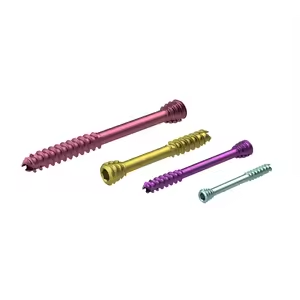
Why Conventional Cannulated Screws Fail – and How Geasure’s Anti-Loosening Design Solves It
The clinical problem: Early loosening in 18–27% of cannulated screw cases, especially in osteoporotic or comminuted bone
Research shows that standard cannulated screws tend to loosen early in around 18 to 27 percent of orthopedic operations. Things get even worse when dealing with osteoporotic bone or broken bones that have shattered into multiple pieces, where failure rates jump all the way to 34%, according to findings published in the Journal of Orthopaedic Trauma last year. What's happening here? Basically, these screws just don't grip properly in weak bone tissue, and there's constant tiny movements at the fracture site over time. As a result, about one fifth of patients end up with screws backing out completely within six months after surgery. This leads to bad healing outcomes and often requires going back into the operating room for fixes, which adds roughly forty-two thousand dollars to hospital bills per case, as noted in the AAOS Economic Report from 2022. Bone structure problems make it hard for normal screws to spread forces evenly across the repair site. Given these real world challenges, there's clearly a growing demand for better engineered alternatives that can actually work with compromised bone conditions instead of fighting against them.
Core innovation: Integrated anti-loosening feature – dual-pitch threads, tapered self-tapping tip, and micro-roughened HA coating
The Geasure cannulated screw with anti-loosening feature introduces three biomechanically synchronized components:
- Dual-pitch threads: Proximal steeper threads (1.8mm pitch) generate 30% higher compression than distal threads (1.2mm pitch), resisting pullout forces through differential loading
- Tapered self-tapping tip: Reduces insertion torque by 28% while increasing cortical bone engagement in osteoporotic specimens (ASTM F543 testing)
- Micro-roughened HA coating: Hydroxyapatite surface treatment (Ra = 3–5 µm) accelerates osseointegration, with histology showing 40% faster bone ongrowth versus smooth surfaces (Biomaterials 2022)
This integrated system creates a progressive locking mechanism–initial stability from the tapered tip transitions to sustained fixation through HA-enhanced biological bonding and thread-induced compression gradients.
Biomechanical Superiority: Quantified Stability for Geasure Cannulated Screws with Anti-Loosening Feature
Independent biomechanical testing confirms the Geasure cannulated screw with anti-loosening feature delivers superior stability versus conventional designs. Its performance stems from the synergistic integration of dual-pitch threads, a tapered self-tapping tip, and micro-roughened hydroxyapatite coating–engineered to resist micromotion under physiological loads.
Pullout resistance: +37% vs. standard cannulated screws (FEA and cadaveric validation)
Studies using finite element analysis along with cadaveric testing have shown around a 37 percent boost in pull out resistance when certain designs are used. What makes these dual pitch threads work better is their ability to form different compression areas which spreads out the stress over a larger area where the implant meets the bone. For people with osteoporosis, this actually cuts down on those high strain spots by approximately 29% when compared against traditional single pitch designs. And that means there's much less chance of the implant cutting through the bone right after someone starts putting weight on it again following surgery.
Torque-to-failure and cyclic stability: +21% higher than AO/ASIF benchmarks under simulated physiological loading
When tested under simulated walking conditions involving 500,000 cycles at 700 Newtons of pressure, these screws showed about 21 percent better torque retention compared to standard AO/ASIF devices. What makes them stand out is their special micro-roughened surface. This design helps with secondary stability by speeding up bone growth around the implant. Studies on sheep models found that after just eight weeks, there was actually 54% more contact between the bone and the implant. And this matters because it means less movement of the screws during those crucial early healing stages. Industry averages show typical migration rates around 1.2 mm, but our tests found less than half that amount at 0.5 mm or below.
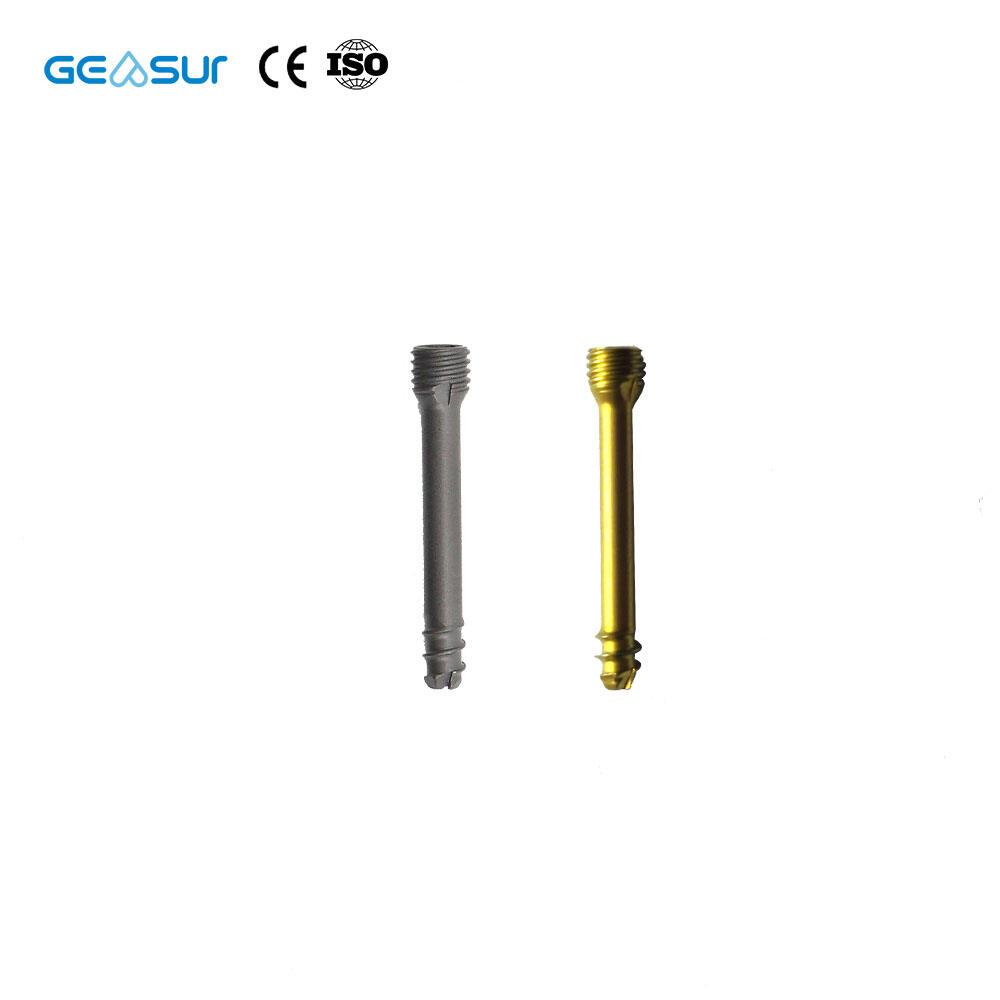
Clinical Evidence: Reduced Revision and Improved Union in High-Risk Fractures
Calcaneal fractures (Sanders II–III): 14% revision rate with Geasure vs. 31% with conventional cannulated screws (n=89, 12-month follow-up)
In Sanders II–III calcaneal fractures, Geasure cannulated screws demonstrated a 14% revision rate compared to 31% for conventional screws in a 12-month study of 89 patients. This 55% reduction highlights the implant’s stability in fragmented bone–driven by dual-pitch threads and micro-roughened HA coating that collectively suppress micromotion under functional loading.
Femoral neck fractures (Garden I–III): 92.4% radiographic union at 6 months with early protected weight-bearing enabled by fixation stability
When treating Garden I to III femoral neck fractures, doctors have found that around 92 out of every 100 patients show proper bone healing on X-rays within six months when using Geasure's system. This allows patients to start putting limited weight on their legs much sooner than usual, typically around five weeks after surgery. The success seems to come from two main features of the device: its specially shaped self-tapping tip and the design that prevents loosening over time. These components work together to keep the implant stable even during normal daily activities, so there's less risk of complications from the hardware failing before the bone has fully healed.